

We’ve covered a lot of ground in this series. Now it’s time to dive into boat sales discovery questions that can help you better understand your clients’ needs.
We’ve talked about why most boat sales fail before they even start. We’ve talked about the polite lies that kill deals. We’ve gone deep on five specific questions — their purpose, their structure, the mistakes to avoid, and the moments they create when done right.
Now let’s pull it all together.
Because understanding each piece individually is valuable. But seeing how they work as a sequence — how one question sets up the next, how the whole thing builds into something genuinely different from anything most buyers have ever experienced — that’s when it really clicks.
Here’s the Complete Picture
The Foundational Five is not a script. It’s a conversation — a deliberate, structured boat sales discovery conversation that happens at a table, before any boats are shown, with a prospect who has already committed to being honest with you.
It takes between 15 and 20 minutes.
And in those 15 to 20 minutes, you will learn more about your buyer — their real motivation, their actual vision, their true must-haves — than most salespeople learn in an entire sales process.
Here’s how the sequence works:
Step One: Sit Down Before You Walk the Dock
When your prospect arrives, don’t walk them straight to the boats. After a few minutes of genuine conversation — enough to start earning trust — you say: “Before we look at any boats, let’s sit down for a few minutes so I can really understand what you’re looking for. Sound good?”
This one move signals immediately that this experience is going to be different.
Step Two: The Honest Agreement (3–4 minutes)
As we covered in the second article, this is your verbal contract — your commitment to honesty and theirs. It creates the psychological safety that makes every answer that follows genuine instead of guarded.
Without this foundation, the next four boat sales discovery questions produce polished answers. With it, they produce truth.
Step Three: The Past (3–5 minutes)
“What’s the most memorable experience you’ve had on the water? Tell me about that day.”
As we explored in the third article, this connects the purchase to emotion rather than logic. Use the Law of Three — follow up at least twice to go deeper. The first answer is the surface. The real answer is underneath.
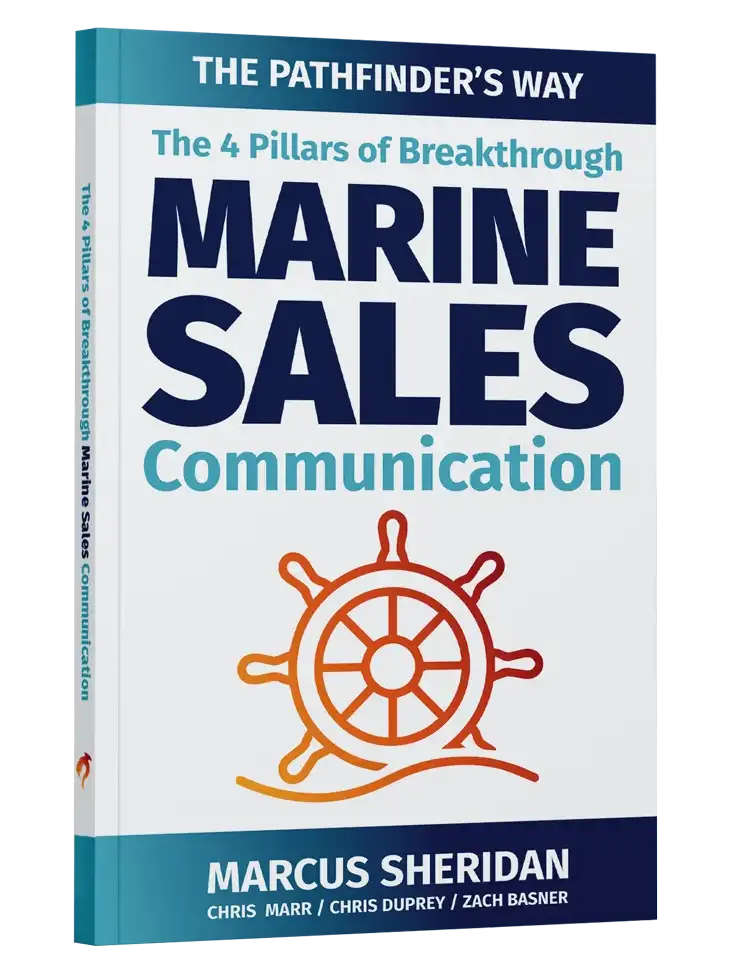
Download The 4 Pillars of Breakthrough Marine Sales Communication for FREE
Get the system that helps marine sales reps move beyond specs and walk-throughs and into high-trust, buyer-led conversations.
Alternatively, order your copy on Amazon:
Step Four: The Present (2–4 minutes)
“Tell me — what made you want to own a new boat at this point in your life?”
As we covered in the fourth article, those last five words do the heavy lifting. You’re not asking why they want a boat. You’re asking why now. The timing reveals the urgency, the emotional driver, and often the most important selling point in the entire conversation.
Step Five: The Future (2–4 minutes)
“When you think about the perfect day on the water, who are you with and what are you doing? Give me as much detail as possible.”
As we discussed in the fifth article, this is where the magic happens. They paint the picture. You listen carefully, you push for specifics, and you write it down — because this vision is what you’ll reference when you show them the boat and when you close.
Step Six: The Non-Negotiables (3–6 minutes)
“When you consider buying your next boat, what are the non-negotiables? What are the must-haves? And why?”
As we explored in the sixth article, the “why” is non-negotiable. It separates true requirements from inherited opinions and helps you catch contradictions before they become objections.
Step Seven: Repeat It Back
Before you stand up, summarize. In their words, reflect everything they shared.
“So here’s what I’m hearing: You want to recreate those moments you had with your son when he was younger. This summer feels like the right time because your daughter has two years left at home. Your perfect day is the whole family anchored at the sandbar, kids jumping off the back, nobody checking phones. And your must-haves are a solid swim platform, room for eight or more people, and reliability above everything else. Am I getting that right?”
Watch what that does. They nod. They lean forward. They say yes — and often add something. Because hearing their vision reflected back to them that clearly, from someone who was genuinely listening, is an experience they weren’t expecting.
Now you stand up. And you walk to exactly the right boat.
What This Produces
When you use the Foundational Five consistently and correctly, several things change.
Your closing rate increases — not because you got better at closing, but because you got better at discovery. You’re no longer showing six boats and hoping. You’re showing one boat, the right boat, for the right reasons.
Discounting decreases. When buyers feel truly understood, price becomes less of the conversation. They’re not comparing you to the dealer down the road on price. They’re comparing the experience. And yours is in a different category.
Buyer’s remorse disappears. Because you took the time to understand what they actually needed, they get the right boat. A year later, they still love it. And they tell everyone.
Referrals increase. People rave about being understood. “You have to work with this person. They actually listened.” That’s the most powerful marketing you’ll ever have — and it’s free.
The Two Paths
Let’s be honest about what you do with this.
Path one: You read through these articles, think “that makes sense,” and go back to doing what you’ve always done. Walking prospects straight to the dock. Asking surface-level questions. Hoping something sticks. Discounting to close. Grinding.
Path two: You commit to actually using this. You sit your team down. You practice the Honest Agreement until it sounds like breathing. You add one question at a time until the whole sequence becomes natural. You role-play — yes, role-play — every week until this is what your dealership is known for.
Here’s what we know from working with marine dealers across the country: The ones who choose path two see closing rates increase ten to twenty percent within a year. Their customers become raving fans. Their team enjoys the job more because they’re guides, not order-takers. And the culture of the dealership changes.
Not because they have better boats. Because they have better conversations.
Your Next Step
Pick one element from the Foundational Five and use it this week. Just one.
Start with the Honest Agreement. Deliver it to every prospect who walks in. Notice what happens — how the conversation changes, how people respond, how the energy in the room shifts.
Then add Step 2 the following week. Then Step 3. Build the habit one piece at a time until the whole sequence is yours.
That is the Pathfinder’s Way.
The marine industry doesn’t need more salespeople who know their inventory. It needs more guides — people who are genuinely curious about the human beings standing in their showroom, who ask boat sales discovery questions nobody else asks, who take twenty minutes to understand a vision before they ever show a boat.
The families walking into your dealership deserve that.
Your team deserves to know how to provide it.
And now, you have exactly what you need to make it happen.
- Take a look at the previous article here: The Discovery Question That Closes More Boat Sales
Download The 4 Pillars of Breakthrough Marine Sales Communication for FREE
Get the system that helps marine sales reps move beyond specs and walk-throughs and into high-trust, buyer-led conversations.
Alternatively, order your copy on Amazon: